


A Just Reality is a Virtual Reality training tool designed to fill a gap in essential skills training for law enforcement when investigating gender-based violence incidents. Virtual Reality (VR) training experiences have proven effective in improving decision-making skills, eliciting empathy, and creating an emotional connection between the trainee and the materials in many domains. By providing an interactive VR scenario where participants interview an emotive avatar, officers learn to avoid biased language and practice victim-centered and trauma-informed techniques when interacting with those reporting gender-based violence.
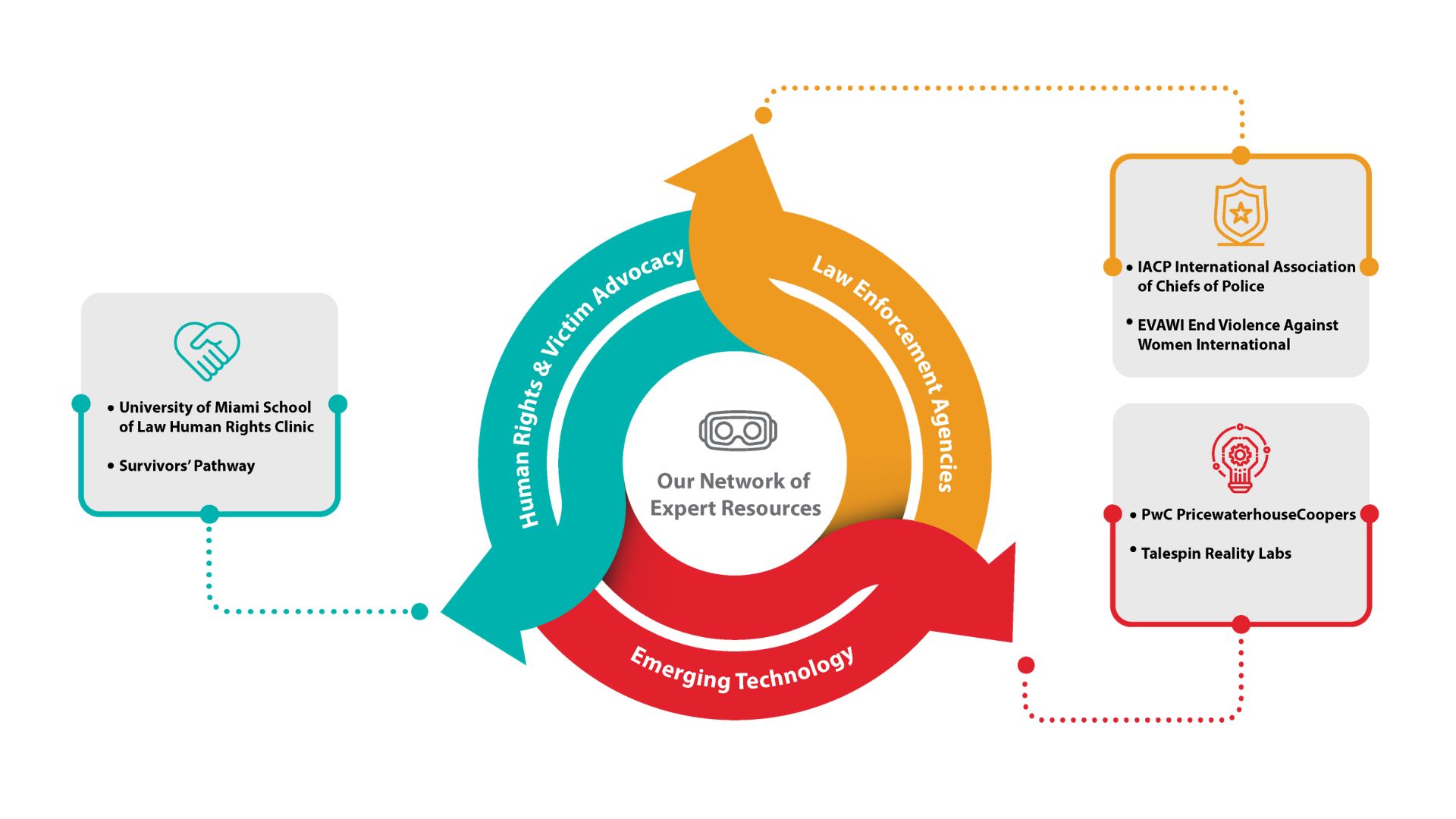
Due to the interdisciplinary nature of this challenge, assembling a team of subject-matter experts was crucial to developing an informed tool. As the lead researcher on this project, I collaborated with human rights & victim advocacy groups, law enforcement, and emerging technology experts to develop the training scenarios. In addition, I also conducted focus groups and qualitative interviews, created branching narratives, ran usability tests with law enforcement officers, authored white papers, and presented at academic conferences.
Despite the prevalence of Gender-based violence (GBV) crimes, less than 40% of women who experienced violence sought any assistance, and of those, less than 10% sought help from the police. The interaction of GBV victims with law enforcement is often marred by skepticism, hostility, and a general lack of sensitivity, which can exacerbate the victim's trauma and hinder the judicial process. Many GBV cases suffer from inadequate evidence gathering and a lack of proper investigative follow-through, contributing to secondary victimization and increased danger for the victims. A Just Reality aims to address these challenges by enhancing police training with a focus on understanding the role of implicit bias and the effects of trauma on victims, which are critical for improving the interactions between officers and GBV victims.
.jpg)
As part of our research efforts, we collaborated with human rights and victim advocacy organizations as well as law enforcement officers to identify gaps in current training practices. Through this work, we found that officers have limited access to authentic, high-stakes training opportunities that reflect the complexity of real-world GBV interviews.
Existing training approaches vary widely in quality and consistency. Lecture-based instruction lacks interactivity, while role-play-based learning is inconsistently implemented and challenging to scale due to resource, cost, and staffing constraints. A notable topic gap exists, as the majority of law enforcement training prioritizes tactical skills and de-escalation protocols, with comparatively limited focus on essential interviewing skills, trauma-informed practices, and bias awareness.
Feedback from the International Association of Chiefs of Police (IACP) highlighted a preference for repeatable and consistent training experiences. Through our research, we identified that the victim interview scenario would be a novel area for VR training simulations as it offers an ideal environment that allows officers to practice victim-centered, trauma-informed skills and uncover biases through interview scenarios with victims of GBV. As a result, we decided to create an immersive training scenario that provided law enforcement officers repeated opportunities to practice investigative approaches in a space that allows for risk-taking, exploration, and self-discovery.
.jpg)
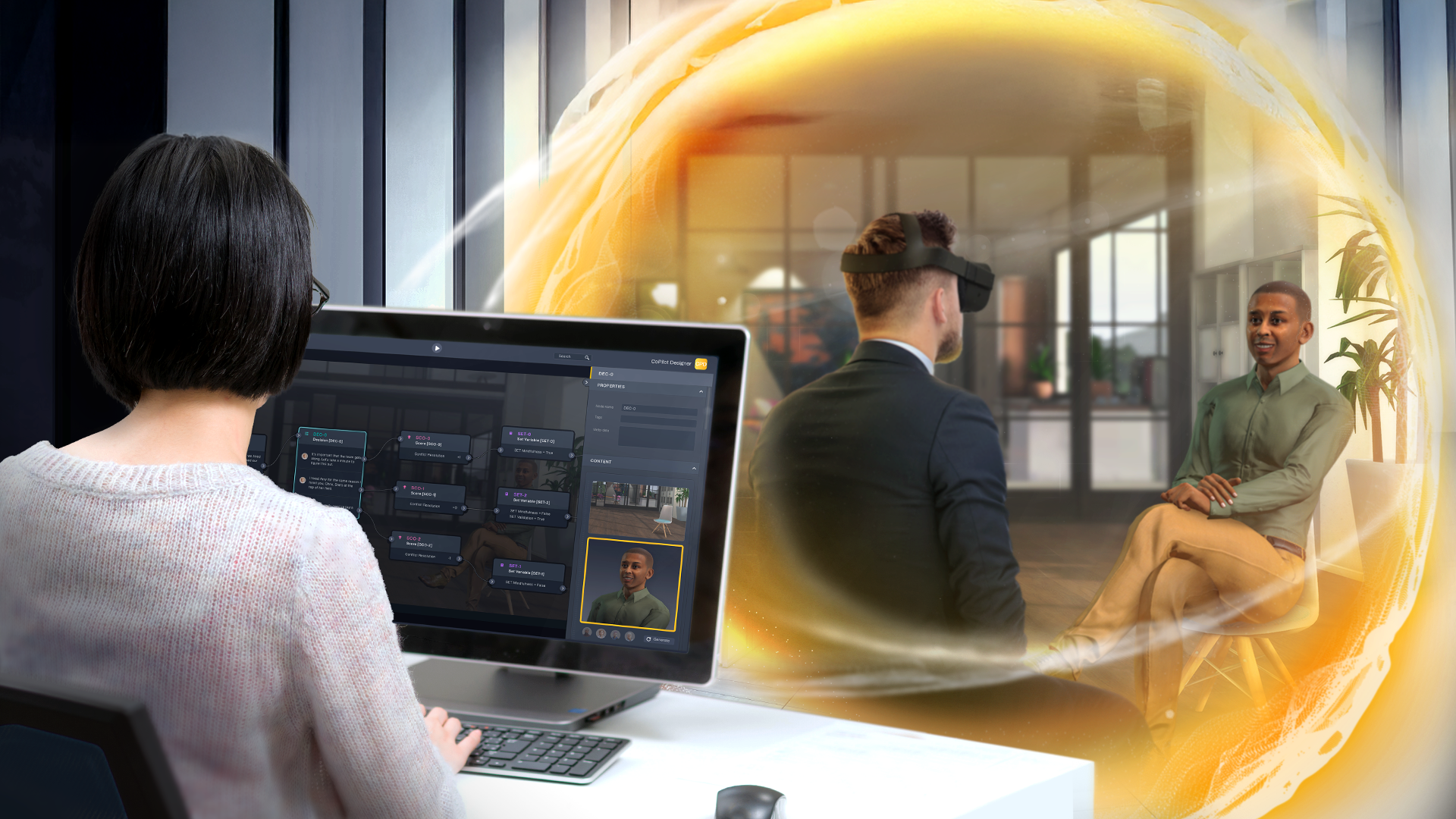
Guided by our research, we created a branching dialogue tree for each training scenario, outlining the user’s choices. Using the branching dialogue trees, we developed a prototype VR training module using Talespin’s proprietary Co-Pilot Designer software. We then proceeded to incorporate animations, body language cues, voice line generation, and a scoring system to monitor user performance. To maintain authenticity, all training scenarios, including crime details, assailant types, and victim profiles, were based on scripts or materials sourced from credible law enforcement agencies or victim-centered advocacy organizations.
The prototype consisted of a VR-compatible training module featuring a specific interview scenario designed for law enforcement personnel to apply and practice trauma-informed interview techniques. Within this interactive narrative experience, officers can complete the training module multiple times and make different choices, thereby supporting skills-based learning, which is recognized as an effective pedagogical application of VR. The 10-15 minute immersive VR experience enables users to select dialogue options based on best practices for trauma-informed interviewing, while the virtual character being interviewed responds with dialogue, facial expressions, and gestures.
.jpg)
Developed using Talespin’s Co-Pilot Designer, A Just Reality was distributed and tested via both VR headsets and desktop browsers. Iterative testing with law enforcement officers, subject matter experts, and DePaul community scholars facilitated the refinement of the narrative structure, character development, user interaction, and feedback scoring mechanisms.
Users are evaluated in the categories of Professionalism, Interview, Empathy, Active Listening, and Trust, receiving feedback during and after the experience to support the development of trauma-informed interviewing skills. While some officers expressed frustration with the pre-written dialogue options, noting the inability to “speak in their own words,” overall responses to the project have been highly positive. As one participant from Chicago’s Buffalo Grove Police Department stated, “The scenario and inflection of the victim felt very authentic. The change in facial expression and body language had similarities with victims interviewed in the past.”
Subsequent research will prioritize finalizing the prototype design in response to stakeholder feedback on scenario content. This will be followed by a formal evaluation to determine the effectiveness of the training approach in increasing officer empathy and reducing bias. Furthermore, future studies will investigate the integration of generative artificial intelligence and large language models (LLMs) to further support and improve both the training design and evaluation process.
Rego, C. “A Just Reality: Designing for VR to create empathetic essential skill training.” Presented at XR for Change held in person, Jul 20, 2023
Rego, C. (2024)“Developing a Trauma-Informed Interviewing Training Module Prototype for Law Enforcement Using Virtual Reality.” Poster and demo presentation scheduled on May 24th-26th, 2024, at the Meaningful XR Conference held in person.
I create meaningful & interactive experiences through design. My prior experience as a Business Analyst combined with my skills as a UI/UX designer gives me the unique ability to analyze both client and user needs to come up with creative solutions.